Tabletop Gaming: From Casual to Corporate
Neoliberalism and the Changing Ethos of Role Playing Games.
2/18/20263 min read
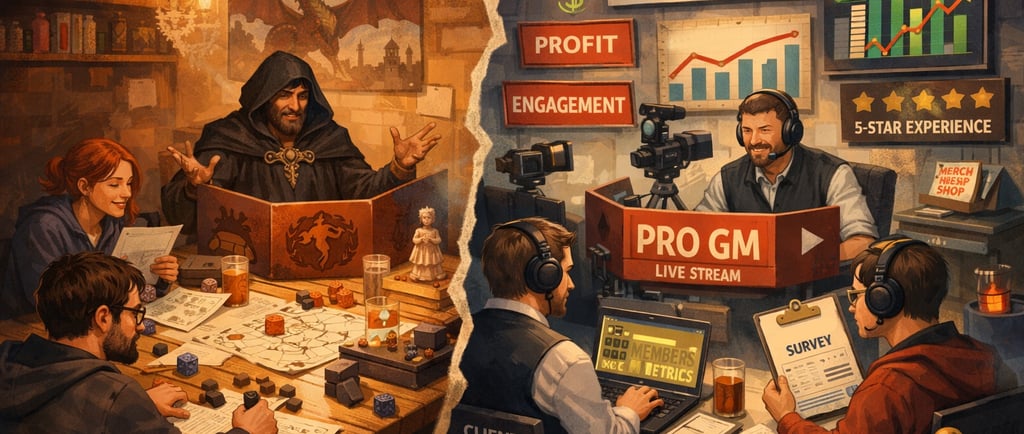
Over the past few decades, an economic and managerial mindset has expanded far beyond the marketplace. What began as a theory about how best to organise markets has gradually become a broader cultural logic about how to organise everything. This logic is often described as Neoliberalism. It does not simply argue for private enterprise. It encourages the application of market principles, competition, metrics and consumer choice to institutions that were not originally conceived as profit generating enterprises.
The effects of this shift are most visible in large public institutions. The National Health Service, founded on the principle of universal care as a public good, has increasingly been managed through internal markets, performance targets, outsourcing contracts and efficiency drives. Universities, once self understood primarily as communities of scholarship, now frequently describe students as customers, degrees as products and research in terms of measurable impact and revenue generation. In both cases, defenders argue that these reforms increase accountability and efficiency. Critics counter that they subtly alter the purpose of the institution itself. Care becomes throughput. Education becomes service delivery. Intellectual risk gives way to brand management.
At first glance, role playing games seem far removed from such concerns. They are collaborative storytelling exercises, imaginative and social by nature. Traditionally they have been organised informally: a group of friends around a table, a shared world, no financial stakes beyond splitting the cost of snacks and books. Yet even here the same managerial logic is becoming visible.
One development we’ve seen in recent years is the rise of the paid Game Master. There’s nothing inherently wrong with compensating someone for their time and effort. We all know how long it takes to prepare these games, but once a fee is introduced, something fundamental shifts in the social relationship – the GM becomes a service provider and the players become their clients. Expectations become formalised. Satisfaction becomes a measurable outcome. Reviews and ratings follow. The ethos of mutual co-creation begins to resemble a transaction.
Another change is the increasing emphasis on monetisable content ecosystems. Streaming platforms, subscription services, branded campaigns and intellectual property management have expanded the hobby’s reach, and this has often been a positive development. But this also encourages optimisation for audience metrics. Adventures may be designed for watchability as much as playability. Systems are built with scalability and brand coherence in mind. Creative risk may be filtered through concerns about market reception.
There is a subtle shifts in the language used. Groups discuss value for money, deliverables, content cadence, audience growth. None of this appears oppressive, but it reorients the purpose of play. Instead of asking what kind of story a group wants to tell, the framing can become what kind of experience can be reliably delivered.
The comparison that might be made with the NHS and universities is not that RPG groups are collapsing under bureaucratic weight, it is that a similar pattern of thought appears across these domains. Market logic excels at coordinating production and distribution, but it struggles with goods that are relational, emergent and intrinsically motivated. Healthcare, education and collaborative storytelling all share a common feature: their value cannot be fully captured in metrics without distorting them.
There is also a question of freedom. Neoliberal culture celebrates individual choice. In gaming, this translates into an abundance of systems, platforms and purchasable experiences, but structural pressures shape which games are visible, which styles are promoted and which creators can sustain themselves. Algorithms elevate certain aesthetics. Sponsorship models reward particular tones. The paradox is that the apparent expansion of choice can coexist with a narrowing of viable alternatives.
This doesn’t mean that commercialisation is inherently corrupting. Commercialisation of role-playing games began in the very early years of Gary Gygax. Markets have enabled wider distribution, higher production values and access for people who might never have encountered the hobby otherwise. The issue is not whether money should exist in the ecosystem, it is whether the organising logic of profit and optimisation should define its core.
When every sphere of life is treated as a business, something subtle happens. Activities once justified by intrinsic goods, care, knowledge, friendship, imagination, are reframed as services, outputs and revenue streams. Over time, participants internalise this framing. They begin to evaluate themselves and others through its lens.
Role playing games emerged as spaces of voluntary imagination, collaborative risk and unstructured exploration. They thrive on trust and shared vulnerability. If they are increasingly managed like small enterprises, with customers, brands and growth strategies, it is worth asking what is gained and what is lost.
The broader lesson from the NHS and universities is not that markets should be abolished, nor that we can return to an earlier era unchanged, it is that institutions have purposes beyond efficiency. When the managerial mindset becomes universal, it can flatten those purposes into a single metric. The challenge for gaming communities, as for public institutions, is to decide whether they will allow that flattening to define them, or whether they will consciously preserve forms of value that resist quantification.
Tabletop gaming, at its best, is not a product – it is a shared act of imagination. Whether it remains that way depends less on economic inevitability and more on the choices communities make about what they believe their activity is for.
© 2026. All rights reserved.